Bought crypto in multiple chunks and now you’re thinking, “Mera real price kya hai per coin?” Or maybe you purchased a tube of bullion coins and want to know if you overpaid per piece. A price per coin calculator helps you convert messy totals (including fees) into one clean number: your cost per coin in AUD. Simple concept—big impact. Is guide me you’ll learn the meaning, formulas, step-by-step method, pro tips, common mistakes, and Australia-specific tax/record angles so you can calculate confidently.
Price per coin calculator: meaning & definition
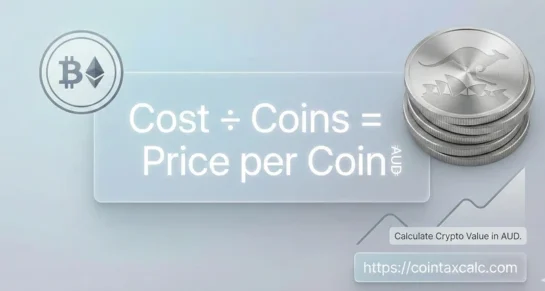
A price per coin is basically the cost of one coin when you purchase multiple coins together. The most basic formula is:
Price per coin = Total Cost ÷ Number of Coins
This looks “too easy,” but the magic is in what you include inside Total Cost—especially in crypto (trading fees, spread, network withdrawal fees) and in bullion/collectibles (premium, shipping, insurance).
Three different “price per coin” calculators people actually mean
Because the keyword is broad, Aussies often mean one of these three use-cases:
Bulk-buy cost per coin (simple unit cost)
You paid $X total, got Y coins → what’s $ per coin?
Average cost per coin (multiple buys / DCA weighted average)
If you bought the same coin many times at different prices, your “true” average is a weighted average (not a simple average). Tools called “average cost calculators” are built for exactly this.
Market cap to price per coin (token valuation math)
In crypto, price is directly linked to supply and market cap:
Market cap = price × circulating supply
So a “market cap to price” calculator reverses it:
Price = market cap ÷ circulating supply (same relationship, flipped).
Benefits of using a price per coin calculator
A price per coin calculator is a “small” tool that fixes big decision mistakes:
It makes different offers comparable. Example: two exchanges show slightly different totals; once you convert to AUD per coin including fees, you can compare properly. Even converters and calculators note that real conversions can involve exchange or network fees—your final cost isn’t only the headline price.
It reveals your real break-even. Your break-even is not “the chart price I saw,” it’s your average cost per coin including fees (especially if you DCA).
It helps set realistic token targets. If you dream of a token reaching $10, check what market cap that implies using price = market cap ÷ supply (and compare it with existing market caps). CoinGecko explains market cap as price multiplied by circulating supply, so this math is grounded in how valuations are discussed publicly.
It supports cleaner ATO records. In Australia, the ATO emphasizes valuing crypto in AUD when you acquire/dispose, and it also runs a crypto asset data-matching program. Knowing your AUD cost base per coin helps you keep cleaner transaction records.
It’s useful beyond crypto—in Aussie coins too. For silver/gold coins, calculators estimate metal (melt) value; and in Australia, guides note many older silver coins are traded for bullion value, while some coins also carry numismatic premiums.
Price per coin formulas you’ll use most
Here’s a quick formula cheat-sheet (jo aap baar-baar use karoge):
| Use-case | What you’re solving | Formula | Best when |
|---|---|---|---|
| Unit cost (single buy) | cost per coin for one purchase | Price per coin = Total cost ÷ coins received | bulk buys, coin rolls, one trade |
| Weighted average (multiple buys) | average cost per coin across many buys | Avg cost = (Σ coinsᵢ × priceᵢ) ÷ (Σ coinsᵢ) | DCA, multiple entries |
| Market-cap implied price | “If market cap becomes X, what’s price?” | Price = Market cap ÷ circulating supply | token valuation sanity checks |
| Market cap (forward) | “Given price and supply, what’s valuation?” | Market cap = price × circulating supply | compare project sizes |
Step-by-step guide to use a price per coin calculator
Below is the most practical flow. You can do this manually, in a spreadsheet, or inside your own website calculator.
Step-by-step (single purchase: simplest method)
- Collect your total paid in AUD (include trading fee; include deposit fee if it directly affected your spend).
- Note the exact coins received (after fees; after any “taker fee” deductions).
- Apply: Total cost ÷ coins received.
Example (Crypto, Australia)
You spent A$1,012 total (including fees) and received 0.50 ETH.
Price per coin = 1,012 ÷ 0.50 = A$2,024 per ETH. (Easy, clean, comparable.)
Step-by-step (multiple buys: weighted average / average buy price)
If you bought the same coin at different times, don’t do a simple average of prices. Use weighted average (like most “average cost calculators” do).
- List each buy as: coins bought and AUD cost (including fees).
- Add all costs → Total AUD spent.
- Add all coins → Total coins accumulated.
- Average cost per coin = Total AUD spent ÷ total coins (this is equal to the weighted formula).
Example (Weighted average in AUD)
| Buy | Coins bought | Total paid (AUD) |
|---|---|---|
| Buy 1 | 0.20 BTC | 18,000 |
| Buy 2 | 0.10 BTC | 11,000 |
| Total | 0.30 BTC | 29,000 |
Average cost per BTC = 29,000 ÷ 0.30 = A$96,666.67 per BTC.
Step-by-step (market cap → price per coin)
This helps kill unrealistic “price predictions” fast.
- Choose your target market cap (in AUD or USD—just be consistent).
- Use circulating supply (not “max supply” unless you’re intentionally modelling dilution). CoinMarketCap defines circulating supply as an approximation of coins circulating in the market/public hands.
- Apply: Price = market cap ÷ circulating supply.
Example
If a token’s circulating supply is 200,000,000, and you think it can reach a A$1,000,000,000 market cap:
Price = 1,000,000,000 ÷ 200,000,000 = A$5 per coin.
Step-by-step (bullion/collectible coins in Australia)
For precious metal coins, you’ll often compare:
- Your price per coin paid (unit cost)
- vs melt value per coin (metal value based on spot price and metal content)
In Australia, calculators exist that estimate melt values for Australian silver and gold circulating coins based on current market prices and show values in AUD.
Also, The Perth Mint highlights that many old Australian silver coins are traded for bullion value, and even notes historical silver content ranges (e.g., pre-decimal coins minted 1910–1945 at 92.5% silver; later dates at 50%; and the 1966 round 50c at 80% silver).
Tips & best practices (Australia-focused)
Include “real cost,” not just sticker price.
For crypto conversions, calculators may show a clean conversion rate, but real trades can involve exchange fees and network fees. Treat “price per coin” as all-in cost if you want truthful comparisons.
Always convert to AUD for ATO clarity.
The ATO stresses valuing crypto in Australian dollars for CGT events, and notes that from 1 January 2020 it has used Reserve Bank of Australia exchange rates. So even if your exchange shows USD pricing, your record-keeping should support AUD values at the time of each transaction.
Separate “calculator types” in your mind.
Don’t mix these up:
- “My cost per coin” (what you paid)
- “Market price per coin” (current rate)
- “Market-cap implied price” (valuation scenario)
Same coin, three different numbers—each useful for different decisions.
People searching price per coin calculator often ask these:
Conclusion + CTA
A price per coin calculator is one of those tools that feels basic—but it protects you from overpaying, misreading your break-even, and making unrealistic price expectations. Whether you’re calculating your crypto average buy price in AUD, estimating a token price from market cap and circulating supply, or comparing bullion coins against melt value, the method is the same: get your inputs right, include fees, and stay consistent with AUD conversions.
If you found this useful, bookmark it and try the formulas with your latest transaction today—your “true price per coin” might surprise you.